
Of the many mysterious behaviours cats exhibit, one of the biggest is also one of the most disgusting: Why do they insist on eating grass, when it only seems to make them throw up? Scientists have proposed many theories over the years, but the latest may be the one that sticks—literally. In a study published last month in the Journal of Veterinary Behaviour, researchers show the grass species felines eat tend to be jagged and covered in spikelike projections. That allows them to latch onto intestinal hairballs, the team proposes, potentially helping cats dislodge them.
The study suggests cats may have figured out how to take advantage of features that plants originally evolved for self-defence, says T. Michael Anderson, an ecologist at Wake Forest University. “This could be another fascinating example of how animals use plants in ways that don’t involve getting calories and nutrients by eating them.”
Hairballs come with the territory of being a cat. Our feline friends swallow lots of fur during grooming, even more if they eat furry prey. The thick bulk can block their digestive systems—until it’s thrown up. Although scientists generally claim that cats eat grass to get rid of intestinal worms, some people suspect they do it to help expel hairballs. So far, there’s been no evidence to support this, however.
So in the new study, Nicole Hughes, a plant biologist at High Point University, focused not on cats, but on the greens they eat. “I know what grass looks like—it’s spiky and likely to snag,” she says. A mum to two tuxedo cats—Mildred and Merle—Hughes has been saving their hairballs for years, waiting for the right research project to come along. That’s just what happened when undergraduate student Kara Bensel, now an animal behaviourist at Appalachian State University, joined the lab.
Together, Bensel and Hughes clipped off bits of six homegrown hairballs and coated them in gold—a necessary step for scanning them with an electron microscope. Detailed images of the plant matter embedded in the hair wads revealed both jagged edges and trichomes, spikelike projections that stick out like prongs. Depending on the plant, those microstructures were two to 20 times longer than cat hairs were wide—meaning they were just the right size to snare fur.
Hughes says it was like looking at drain snakes, jagged coils of plastic designed to yank human hair out of bathroom sinks. Cat parasites like roundworms and tapeworms are up to 60 times larger than these plant microstructures—too large to be snared. That makes parasite removal a less likely reason cats eat grass, Hughes says.
Most of the plants found in the hairballs were common backyard grasses and indoor house plants such as spiderwort, according to a genetic analysis by Megan Rudock Bowman, a geneticist also at High Point. All are fairly rough surfaced, at least at the nanometer level. It’s as if the cats were specifically choosing microscopically scratchy plants, Hughes says.
The findings hint at how plants could trap cat hair, says Benjamin Hart, a veterinary behaviourist and professor emeritus at the University of California, Davis. Still, he doesn’t think the study proves this is the reason cats eat grass. He also notes that dogs and other animals that don’t suffer from hairballs eat grass, too. Instead, he believes the behaviour is an evolutionary holdover from an ancient ancestor that may have munched grass to expel parasites. “Now they’re just hard-wired to do it.”
Hughes remains curious, and Mildred and Merle remain her test subjects. Her next question: If spiky grass helps cats expel grass from their mouths, might it also ease expulsion out the other end? She’s been storing her cats’ poop in the freezer, waiting again for the right project—and student—to come along.
I talked about this with Danny Hoyland on West Bremer Radio on 14 November 2026. Listen live each week: Saturday 7.40 am (Queensland time), West Bremer Radio.
Source: Gold-covered hairballs may reveal why cats eat grass | Science | AAAS
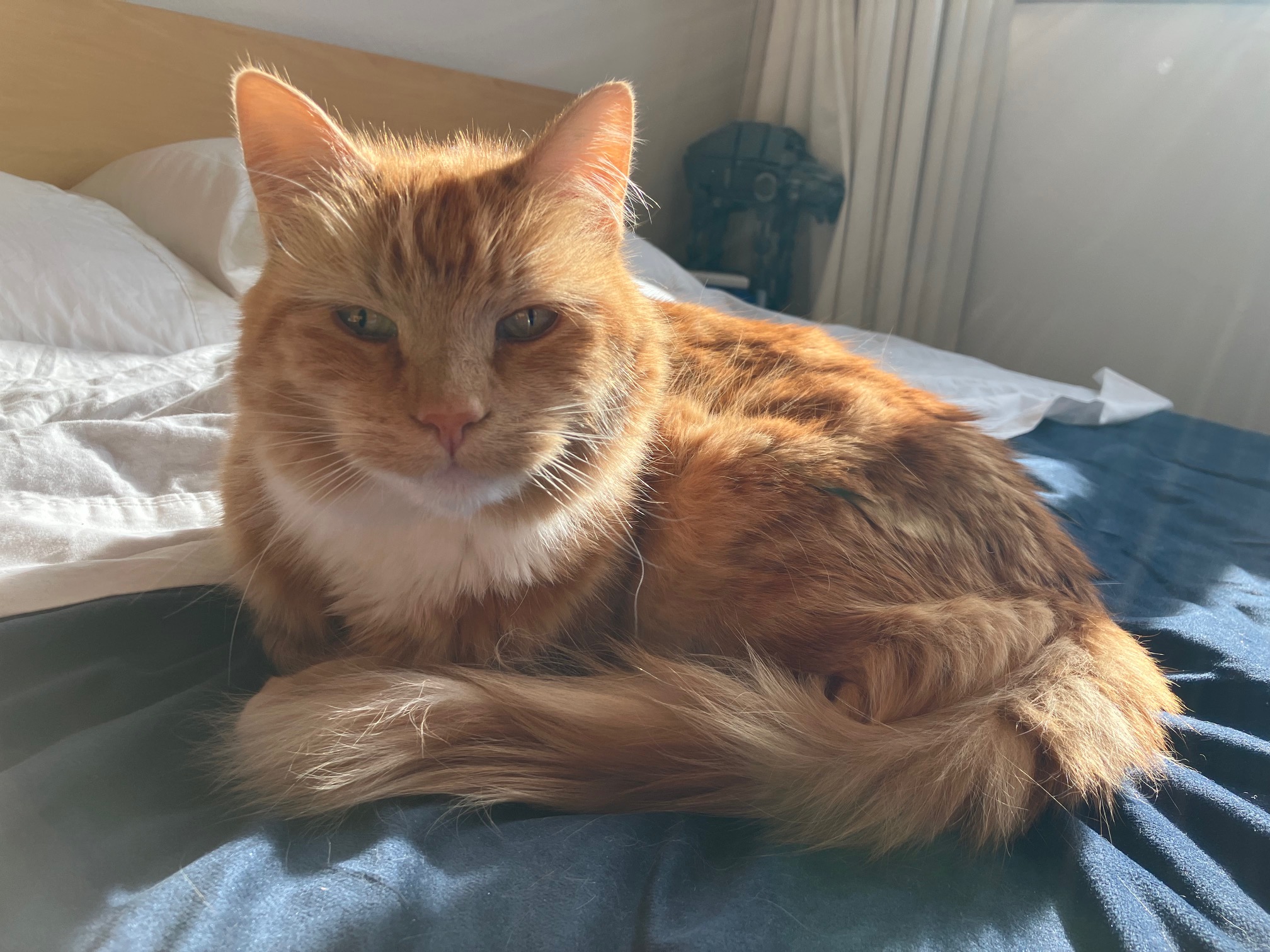
Image credit: My ridiculous orange fluffball, who likes nothing more than chewing on grass on the rare occasion he escapes. And then he vomits. Usually on the carpet.